I used to fall for it all the time.
A brand would say something like "clinically proven to reduce wrinkles by 50% in two weeks" and I'd be at the register before I finished reading the sentence. Behind the counter, I saw customers do the same thing every single shift.
The beauty industry is built on promises. Some of them are real. Most of them are marketing dressed up as science.
I've been burned enough times to know what to look for. If a product uses these three phrases, I put it back immediately.
Red Flag #1: "Clinical Strength" or "Dermatologist-Approved"
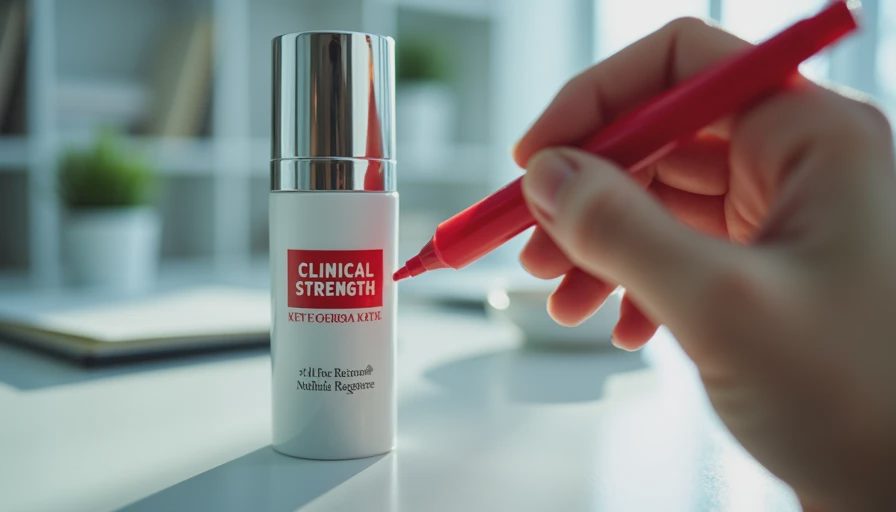
These sound official and scientific. They're usually meaningless.
"Clinical strength" means nothing. There's no standard definition for what constitutes clinical strength in cosmetics. Any brand can put those words on a bottle without meeting any specific criteria.
"Dermatologist-approved" sounds important, but it usually just means a brand paid a dermatologist to review their product. It doesn't mean dermatologists recommend it as a top choice. It doesn't mean the product is particularly effective. It just means one person with a medical degree said it's okay.
The more meaningful language: Look for claims backed by specific studies, with clear methodology. If a product says "in a clinical study of 30 women, 80% saw visible improvement" — that's a real claim. If it just says "clinical strength" without evidence, it's marketing.
Red Flag #2: "Miracle" or "Instant" Results
Anything that promises immediate transformation is usually lying.
Skin doesn't change that fast. Collagen production takes months to improve. Wrinkles don't disappear overnight. Even the best retinol takes weeks to show results.
When a product says "instant smoothing" or "immediate lifting," it's usually talking about an optical effect — like silicone filling in fine lines — not an actual change to your skin. The effect wears off when you wash your face.
The more meaningful language: Look for products that claim results in 4–8 weeks with consistent use. That's how skin actually works. If it promises something faster than that, be skeptical.
Red Flag #3: "Cleans Toxins" or "Detoxifies"
Here's the truth: your body has organs for that. They're called your liver and kidneys.
Your skin doesn't need to detox. It doesn't absorb toxins that need to be pulled out. The idea that a face mask or a body scrub can remove toxins from your bloodstream is not supported by any science I've seen.
What's actually happening: When a product promises to "detox," it's usually a gentle exfoliant that's removing dead skin cells. That's fine, but "detox" is an overpromise. It's the beauty equivalent of selling you a glamorous version of a basic exfoliating cleanser.
The more meaningful language: Look for products that say "exfoliating" or "clarifying." Those are real, measurable effects. Detox is a fantasy.
One More Bonus Red Flag: "100% Natural" or "Chemical-Free"
Everything is chemicals. Water is a chemical. Your skin is made of chemicals. Saying "chemical-free" is a marketing trick that relies on consumers being confused about chemistry.
"100% natural" can be true and still be dangerous. Poison ivy is 100% natural. So is arsenic. Natural is not the same as effective or safe.
What to actually look for: A thoughtful, well-formulated product that uses safe synthetic ingredients where they're appropriate. The clean-beauty movement has made consumers afraid of perfectly good ingredients like preservatives and silicones, which are necessary for product stability and performance.
What to Do Instead of Falling for These Claims
1. Read the ingredient list first, the label second. The front of the bottle is marketing. The back is information. Start there.
2. Look for specific active ingredients. If a product says it's good for anti-aging, it should contain retinol, vitamin C, or other actives. If it doesn't, the claim is useless.
3. Google the brand. Look for independent reviews. Check if there's a pattern of people saying the product works or doesn't. This is faster than returning products.
4. Be skeptical of "proprietary blend." If a brand refuses to disclose how much of each ingredient is in the product, they're probably hiding a weak formulation. Good brands are transparent about percentages.
5. Accept the limits of skincare. No product is going to change your life. The best skincare products are the ones that maintain what you already have.
The Three-Question Test

Before I buy anything with an exciting claim, I ask myself three questions:
Does the brand explain how this product works? Or do they just tell me it works?
Are there independent reviews showing the claimed results? Or just the brand's marketing photos?
Does the price match the formulation? Or am I paying for packaging and advertising?
If I can't answer all three, I put it back.
Bottom Line
The beauty industry is not regulated the way you think it is. Brands can say almost anything on packaging, and there's very little enforcement. You have to be your own filter.
Here's my rule: If it sounds too good to be true, it is. Skin changes slowly. Results take time. Products aren't miracles.
Pretty is nice. Useful is better. And useful doesn't require lying.
— Maya, Chicago
No comments yet — grab the first one.